2026 October 7
One Finger Warrior: Thumb-to-Index Finger Interaction Technique for Mobile Use
Type:
Conference
Authors:
Omang Baheti, Shariff AM Faleel, Rishav Banerjee, Pourang Irani and Khalad Hasan
Venue:
ISMAR '26
Date of publication:
2026 October 7
URL:
data.meta.doi
Abstract:
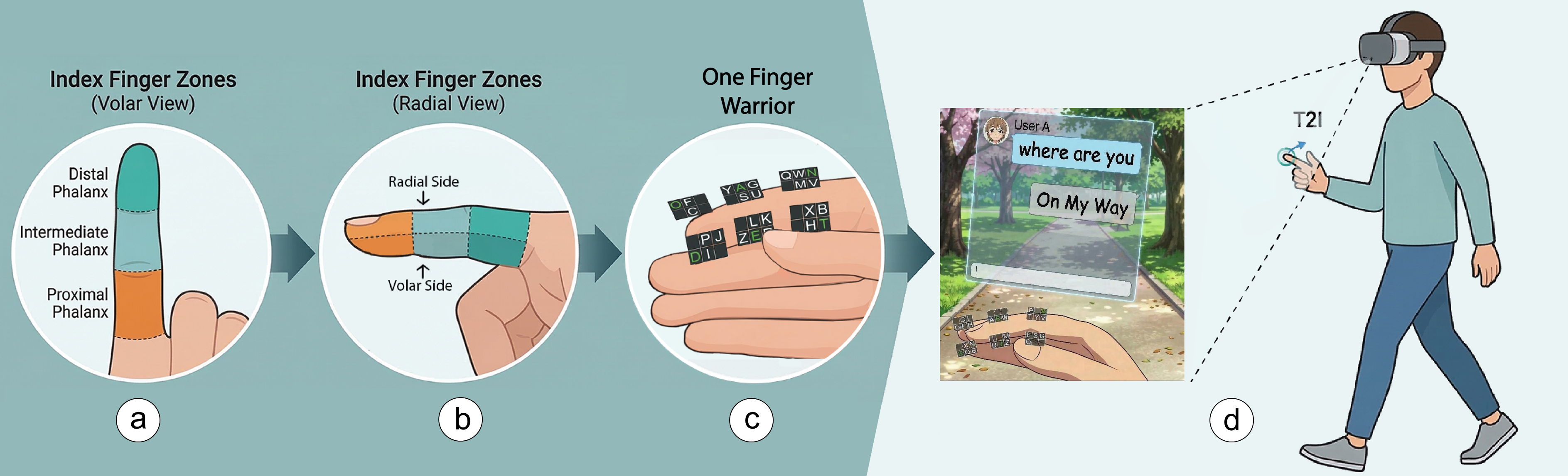
As Head-Mounted Displays (HMDs) become increasingly prevalent, designing User Interfaces (UIs) for quick, on-the-go access is essential. We introduce /One Finger Warrior/, a thumb-to-index-finger interaction technique that enables mobile input on HMDs. The technique segments the index finger into six zones: three on each phalanx of the volar (front) and radial (top) sides. Taps and swipes between these zones allow for a high-density input vocabulary. We examine how different mobility conditions affect interaction speed, accuracy, and comfort, and find that they do not impact user performance in /One Finger Warrior/. Based on this, we design a text-entry application and evaluate its performance envelope by comparing two layout configurations: Optimized and Sub-Optimal. We use a text-entry task as it provides a standardized and cognitively demanding rapid target-selection task that helps characterize the performance envelope of the technique. The performance of both layouts was evaluated under varying mobility conditions. Results show that mobility has no significant impact on performance, with users achieving text entry speeds of 8.31 WPM on the Sub-Optimal layout and 12.05 WPM on the Optimized layout, demonstrating /One Finger Warrior/'s effectiveness for on-the-go input. We present a set of applications that demonstrate /One Finger Warrior/'s ability to enable mobile input on HMDs.
Citation:
Baheti, O., Faleel, S., Banerjee, R., Irani, P., & Hasan, K. (2026). One Finger Warrior: Thumb-to-Index Finger Interaction Technique for Mobile Use. In IEEE International Symposium on Mixed and Augmented Reality (ISMAR)
@inproceedings{baheti26_one_finger_warrior,
  author    = {Omang Baheti and Shariff Faleel and Rishav Banerjee and Pourang Irani and Khalad Hasan},
  title     = {One Finger Warrior: Thumb-to-Index Finger Interaction Technique for Mobile Use},
  booktitle = {IEEE International Symposium on Mixed and Augmented Reality (ISMAR)},
  year      = 2026
}