2026 July 3
A Shape-Changing Afterimage Display Preserving Pixel Density During Surface-Area Changes Across Troposkein-Based Shapes.
Type:
Conference
Authors:
Maxime Daniel, Shariff AM Faleel, and Pourang Irani
Venue:
SIGGRAPH '26
Date of publication:
2026 July 3
URL:
Abstract:
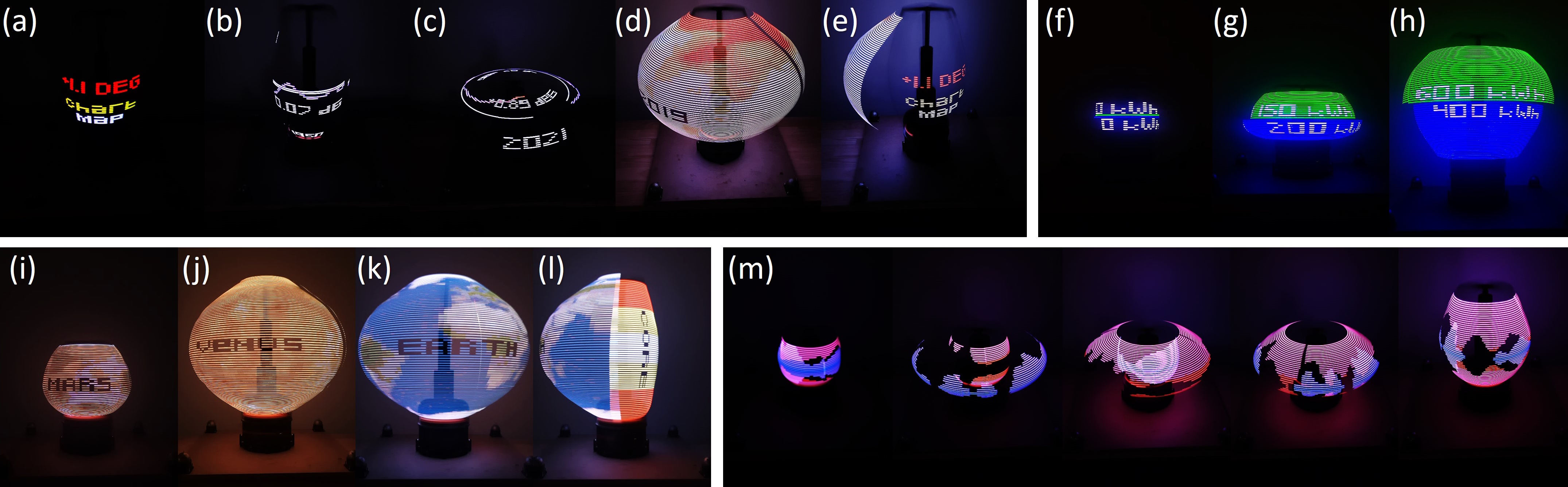
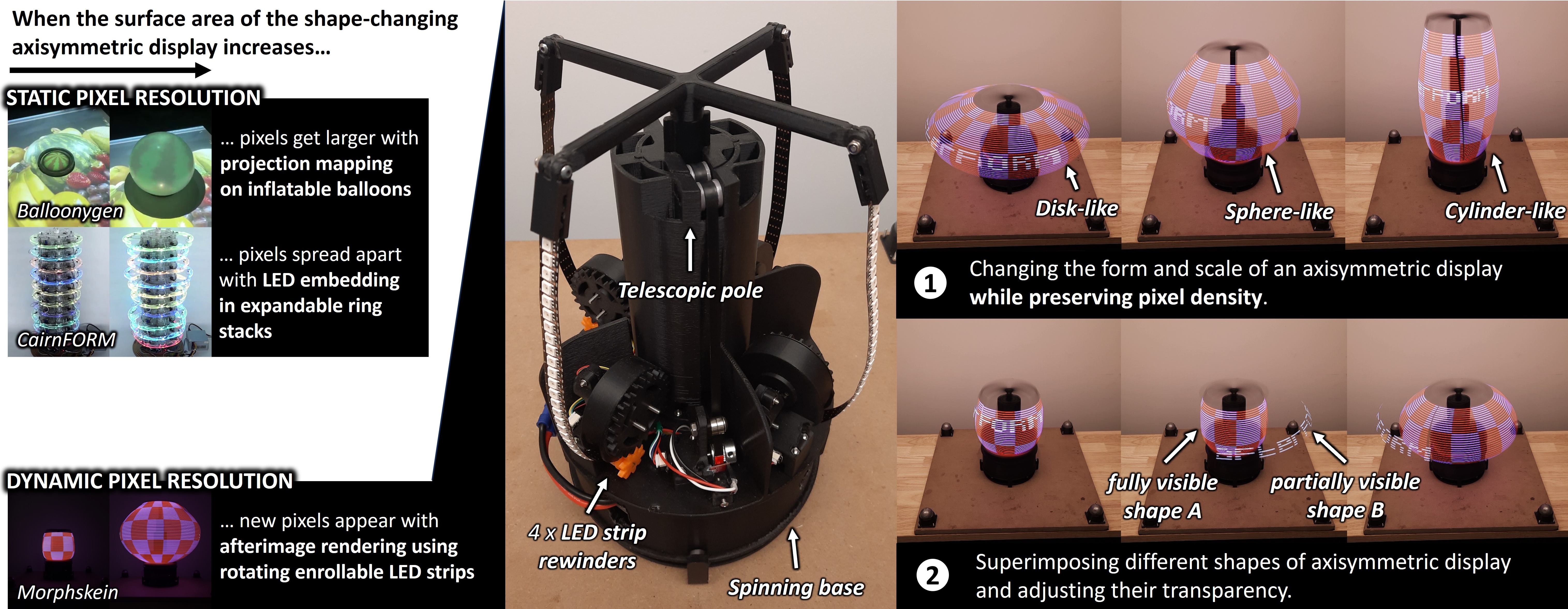
Shape-changing displays typically lose pixel density as surface area expands, limiting their usability. We introduce MorphSkein, a shape-changing after-image display that preserves initial density (1.44 px/cm2) across naturally occurring axisymmetric shapes generated by spinning cables (troposkeins). The system uses a telescopic pole and four LED-strip rewinders on a rotating base. As the strips spin, centrifugal force forms troposkeins, and persistence of vision creates 360°-visible displays, while adjusting pole height and strip lengths changes their shape. As surface area grows, pixel density is preserved vertically by releasing new rows from the rewinders and horizontally by rendering extra columns per revolution with the strips. This keeps comparable density along the central horizontal line of the display, with naturally higher density toward the top and bottom where the troposkein curves inward. Because the technique relies on a mathematical model assuming ideal troposkein geometry, angular velocity becomes critical: incorrect speeds degrade pixel density accuracy, axisymmetric shape fidelity, or both. Interpolation of experimental data shows that 69.44% of reachable troposkein configurations achieve ≥90% density accuracy and shape fidelity for at least one operating speed. Remaining cases degrade due to insufficient motor speed or limited MCU speed and LED refresh rate. Limitations and improvements are discussed.
Citation:
Maxime Daniel, Shariff AM Faleel, and Pourang Irani. 2026. MorphSkein: A Shape-Changing Afterimage Display Preserving Pixel Density During Surface-Area Changes Across Troposkein-Based Shapes. ACM Trans. Graph. 45, 4, Article 40 (July 2026), 11 pages. https://doi.org/10.1145/3811320
@article{10.1145/3811320,
  author = {Daniel, Maxime and Faleel, Shariff AM and Irani, Pourang},
  title = {MorphSkein: A Shape-Changing Afterimage Display Preserving Pixel Density During Surface-Area Changes Across Troposkein-Based Shapes},
  year = {2026},
  issue_date = {July 2026},
  publisher = {Association for Computing Machinery},
  address = {New York, NY, USA},
  volume = {45},
  number = {4},
  issn = {0730-0301},
  url = {https://doi.org/10.1145/3811320},
  doi = {10.1145/3811320},
  abstract = {Shape-changing displays typically lose pixel density as surface area expands, limiting their usability. We introduce MorphSkein, a shape-changing after-image display that preserves initial density (1.44 px/cm2) across naturally occurring axisymmetric shapes generated by spinning cables (troposkeins). The system uses a telescopic pole and four LED-strip rewinders on a rotating base. As the strips spin, centrifugal force forms troposkeins, and persistence of vision creates 360°-visible displays, while adjusting pole height and strip lengths changes their shape. As surface area grows, pixel density is preserved vertically by releasing new rows from the rewinders and horizontally by rendering extra columns per revolution with the strips. This keeps comparable density along the central horizontal line of the display, with naturally higher density toward the top and bottom where the troposkein curves inward. Because the technique relies on a mathematical model assuming ideal troposkein geometry, angular velocity becomes critical: incorrect speeds degrade pixel density accuracy, axisymmetric shape fidelity, or both. Interpolation of experimental data shows that 69.44% of reachable troposkein configurations achieve ≥90% density accuracy and shape fidelity for at least one operating speed. Remaining cases degrade due to insufficient motor speed or limited MCU speed and LED refresh rate. Limitations and improvements are discussed.},
  journal = {ACM Trans. Graph.},
  month = jul,
  articleno = {40},
  numpages = {11}
}