2025 May 26
What's the Thumb Doing? Improving Precision for Thumb-to-Finger Interactions on Hand Proximate User Interfaces
Type:
Conference
Authors:
Shariff AM Faleel, Rishav Banerjee, Omang Baheti, Khalad Hasan, and Pourang Irani
Venue:
GI '25
Date of publication:
2025 May 26
Abstract:
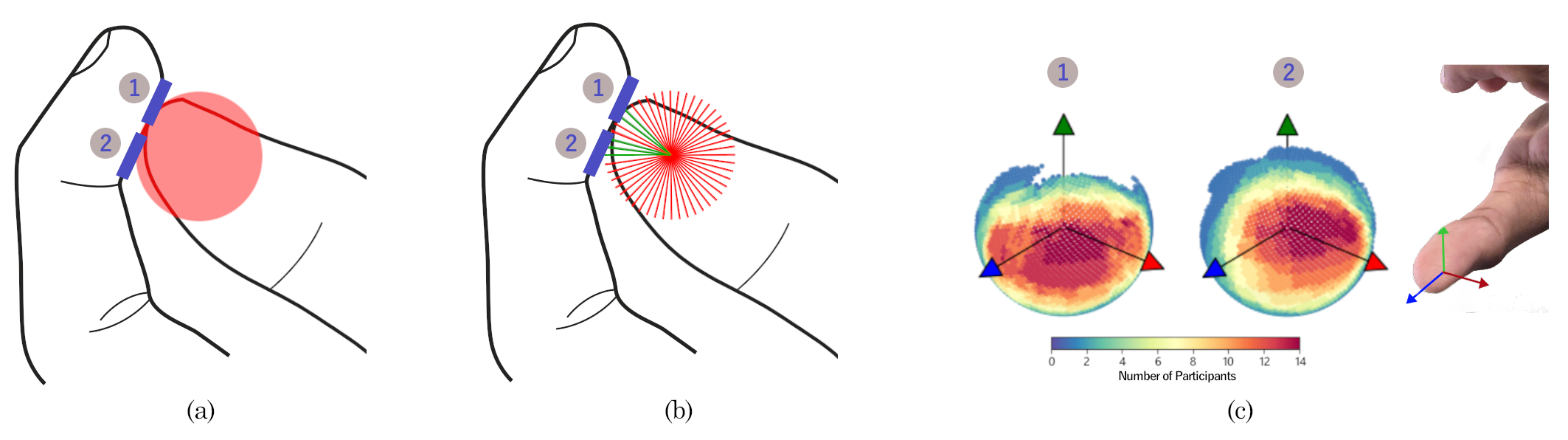
Hand Proximate User Interfaces (HPUI) on Head Mounted Displays (HMD) leverage hand tracking to anchor content on the hand and interact with it using thumb-to-finger interactions. Similar to many other interaction techniques on HMDs, HPUI realizes these interactions by combining simple geometry in game engines. This, in turn, leads to accidental triggers, akin to the 'fat-finger problem' on touch screens. To address this, we explore and provide insight into how the thumb's surface interacts when using HPUI by approximating the thumb's surface with a large number of raycasts. We observe that different regions of the thumb are used when interacting with different parts of the hand. The results also highlight the need to consider the temporal component. We then propose approaches to improving the precision of thumb-to-finger interactions on HPUI and show that these improve target selection accuracy with denser target layouts.
Citation:
Sharif AM Faleel, Rishav Banerjee, Omang Baheti, Khalad Hasan, and Pourang Irani. 2025. What’s the Thumb Doing? Improving Precision for Thumb-to-Finger Interactions on Hand Proximate User Interfaces. In Graphics Interface 2025 (GI ’25), May 26–29, 2025, Okanagan, BC, Canada. ACM, New York, NY, USA, 14 pages. https://doi.org/10.1145/3769872.3769893
For using the raycast based approach for interactions, see the HPUI-Core unity package
   @inproceedings{10.1145/3769872.3769893,
   author = {Faleel, Shariff Am and Banerjee, Rishav and Baheti, Omang and Hasan, Khalad and Irani, Pourang},
   title = {What's the Thumb Doing? Improving Precision for Thumb-to-Finger Interactions on Hand Proximate User Interfaces},
   year = {2026},
   isbn = {9798400718762},
   publisher = {Association for Computing Machinery},
   address = {New York, NY, USA},
   url = {https://doi.org/10.1145/3769872.3769893},
   doi = {10.1145/3769872.3769893},
   abstract = {Hand Proximate User Interfaces (HPUI) on Head Mounted Displays (HMD) leverage hand tracking to anchor content on the hand and interact with it using thumb-to-finger interactions. Similar to many other interaction techniques on HMDs, HPUI realizes these interactions by combining simple geometry in game engines. This, in turn, leads to accidental triggers, akin to the "fat-finger problem" on touch screens. To address this, we explore and provide insight into how the thumb’s surface interacts when using HPUI by approximating the thumb’s surface with a large number of raycasts. We observe that different regions of the thumb are used when interacting with different parts of the hand. The results also highlight the need to consider the temporal component. We then propose approaches to improving the precision of thumb-to-finger interactions on HPUI and show that these improve target selection accuracy with denser target layouts.},
   booktitle = {Proceedings of the 51st Graphics Interface Conference 2025},
   articleno = {21},
   numpages = {14},
   keywords = {virtual reality, game engines, fat-finger, hand proximate user interfaces, thumb-to-finger interactions},
   location = {},
   series = {GI '25}
}